CASE STUDY
Sprout Social AI: Evolving the Product Narrative from AI Features to Intelligent Decision-Making
When Sprout Social's board pushed for more visible AI, I recognized a different problem: the ask was solving for a company signal, not a customer need. I led Brand Creative in shifting the narrative from AI features to what customers could understand and act on in their own business, evolving the story alongside the platform from 2023 through 2026.

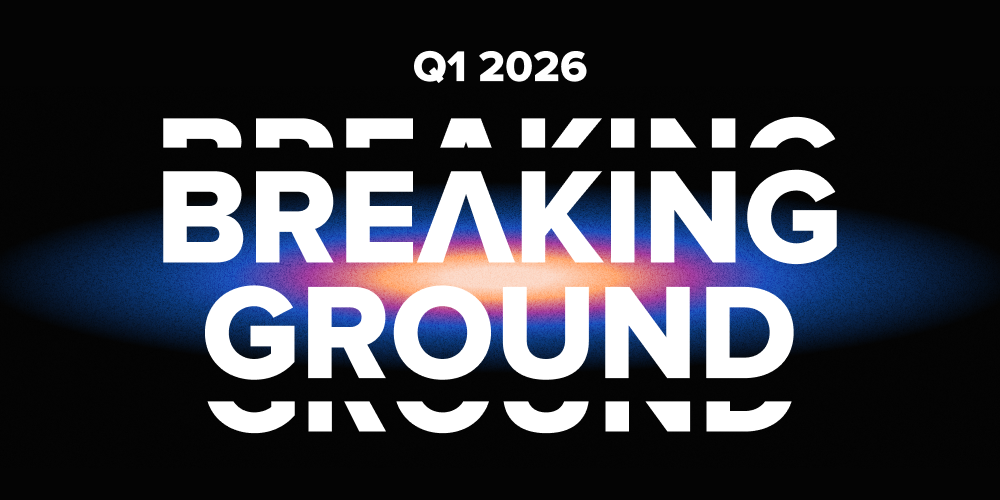
Imagery from Breaking Ground Q4 2025:
The Social-Powered AI Engine, marking the shift toward organization-wide social intelligence.
Overview
As AI became embedded across software categories, the competitive question changed. Companies could no longer differentiate by adding AI features. They had to show why their data, workflows and understanding of customer needs allowed AI to solve a more valuable problem. At Sprout, that meant shifting the narrative from AI-powered social workflows to social intelligence that helped organizations understand customers, anticipate change and make better decisions. In partnership with Product Marketing, I led Brand Creative through that shift.
Market Challenge
Between 2023 and 2026, social media management matured into a category where publishing, monitoring and engaging had become table stakes. At the same time, social data became dramatically more valuable and harder to interpret, as customer conversations expanded across more platforms, channels and communities.
Voice of Customer research, Audience Trends, Tech Stack studies and NPS data showed the same shift from a different angle. Customers weren't asking what the platform could do for them anymore. They were asking how to make sense of everything it was already capturing.
Once every software company could claim some version of AI-powered insight, having AI stopped being the differentiator. The real test became whether a company could help a business understand its customers and act faster on what it learned.
Sprout’s opportunity was not to compete on AI functionality alone. The platform already captured billions of social signals across conversations, audiences and markets. The strategic opportunity was helping customers turn that volume of unstructured data into intelligence they could act on faster than before.
Strategic Shift
In 2024, the board pushed us to make our AI more visible. They were seeing the same signals across the category: the word AI, imagery alluding to it and companies making sure buyers knew they had it. We had appropriate coverage. We weren't behind on any of it.
What I realized was that the request was solving for a company signal, not a customer need. Customers did not need another company telling them it had AI. They needed to understand what AI made possible and why it mattered to their work.
We didn’t need a better AI features page. We needed to change where the story started.
I led Brand Creative in shifting the narrative from what the product could do to what customers could now understand about their business and act on because of it, in close partnership with Product Marketing. That shift moved alongside the platform itself. As Sprout added new capabilities and intelligence sources through product development and acquisition, including Listening capabilities, Influencer Marketing through the Tagger acquisition and predictive intelligence through the NewsWhip acquisition, the customer opportunity expanded too. The story moved from applying AI inside existing workflows to helping organizations understand what was happening and decide what to do next.
Evidence: 2023 to 2026
-
Market Context
Generative AI was entering the mainstream, changing how customers thought about software. While Sprout had used machine learning and AI-driven capabilities within the platform, the broader market conversation shifted. Customers increasingly expected AI experiences they could see, understand and use.
Product Story
Sprout introduced AI capabilities that helped customers apply AI within their existing social workflows, support content creation and generate ideas, improve workflow efficiency and help teams manage social work more effectively. In partnership with Product Marketing, we shaped the product narrative to make those capabilities feel like a natural part of the workflows customers already used.ption text goes here
-
Market Context
By 2024, AI expectations were changing across the software landscape. The question started shifting from what AI could do to what it should free people up to do instead. This is also when Sprout gave the AI story its own stage: Breaking Ground launched in June 2024 as the company's first customer-focused product showcase and became the venue for introducing this new AI positioning.
Product Story
Sprout expanded a set of AI Assist tools across content creation, Listening and Customer Care, helping customers generate suggested responses, summarize conversation trends and produce accessibility features like alt-text and subtitles. We built the story around a single idea: a human-centered approach to AI that automated the routine work so people could spend their time on strategy and creativity that required human judgment. One customer, Minor Hotels, reported saving more than 192 hours a year on reporting alone.Description text goes here
-
Market Context
By 2025, AI capabilities were becoming increasingly common across software categories. That opportunity was expanding beyond introducing individual AI features to demonstrating how AI could create value across more customer workflows.
Product Story
Sprout expanded AI-powered capabilities across the platform, and we broadened the story alongside it as new capabilities and intelligence sources came together:
AI experiences supporting social workflows
Influencer Marketing capabilities strengthened through the Tagger acquisition
NewsWhip added predictive intelligence and expanded Sprout's ability to help customers understand emerging conversations
Trellis introduced a new AI agent experience
-
Market Context
By 2026, AI had become table stakes across the category. The opportunity was helping customers understand how Sprout's unique social data could create clearer insight, greater foresight and more informed action.
Product Story
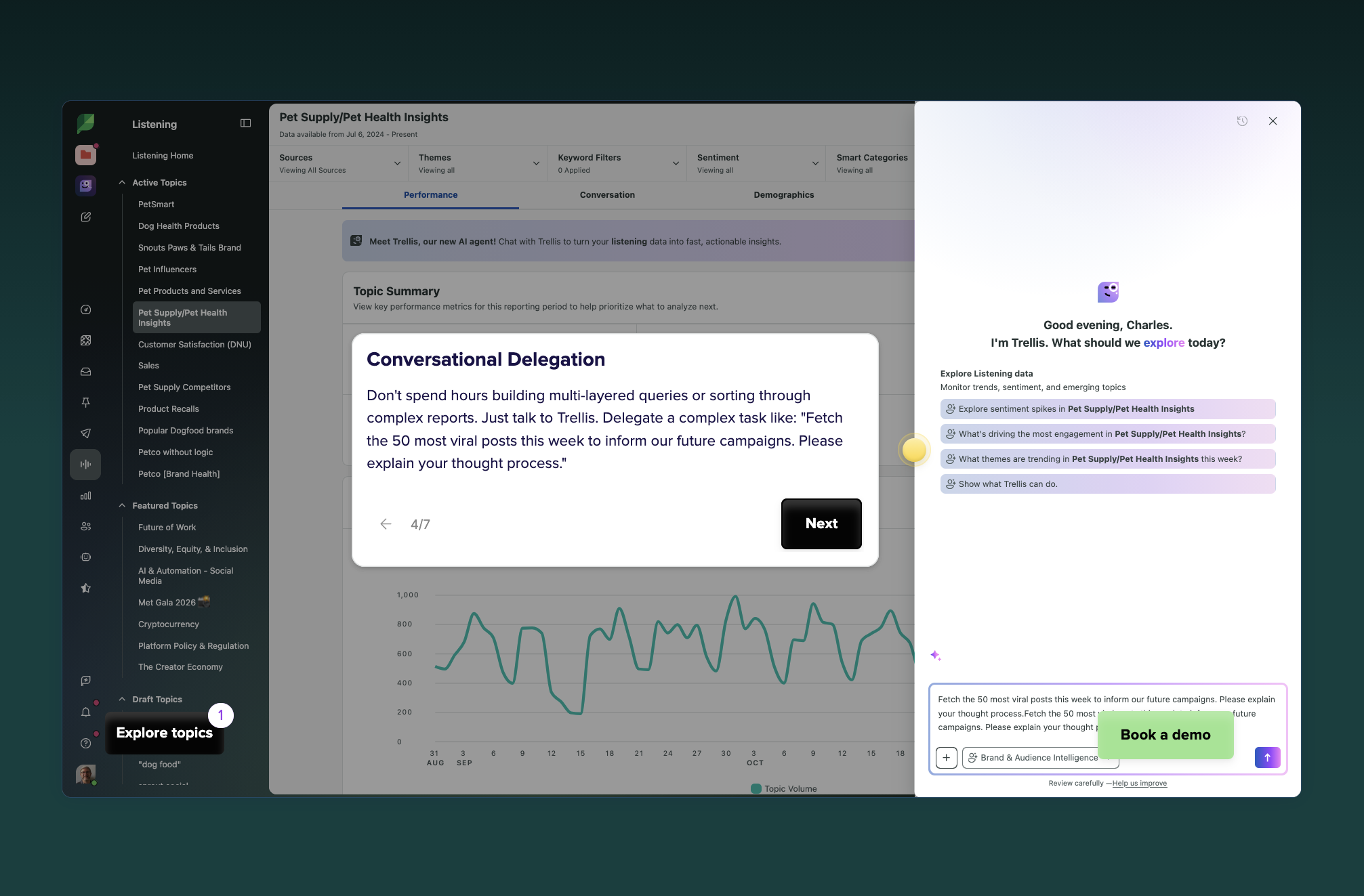
Trellis and Social Intelligence represented connected but distinct investments in that shift, and we treated them as two different parts of the customer story. Trellis, launched in 2025, matured into an AI agent customers could ask questions of directly instead of manually searching through their data, and the promise was simple: turn social data into business answers.
The 2026 AI narrative we built on that foundation:
Converting billions of unstructured social data points into actionable business answers
Turning social signals into foresight, not hindsight
Freeing teams from digging through data to focus on what it means
Alongside it, we carried Social Intelligence's broader repositioning narrative, closing the gap between insight and action so organizations could see what customers, markets and emerging opportunities were signaling and move on it faster than they had before.
Translating Product Strategy Into Customer Experience
A complex product evolution only matters when customers can understand the value. As Sprout's AI capabilities expanded, Brand Creative translated product positioning and messaging into customer-facing experiences across key surfaces, partnering closely with Product Marketing:
AI webpages
Product tours
Launch storytelling and video
Breaking Ground product education
Sales support materials
We connected the underlying capabilities- the AI models, the automation, the agents, the data analysis- to what customers actually got out of them: clearer insights, a better understanding of their audience, faster identification of opportunities and more informed decisions. The goal was to help customers understand not only what Sprout built, but how those capabilities could change the way they worked.


My Role
As VP of Brand Creative, I led the team responsible for Sprout's brand expression and product storytelling across major launches and customer education moments. I also built Sprout's Brand & Customer Insights capability and owned the web experience strategy, creating stronger connections between customer understanding, product evolution and market expression. I helped teams align around the customer problem the product was solving, then translated that understanding into the narratives, experiences and systems customers encountered.
That meant treating Brand Creative as more than a creative execution function. I made sure the team understood our product and our partners' strategic priorities as deeply as Product and Product Marketing did, so we could help shape value claims and pillar messaging from the beginning rather than applying narrative after decisions were already made. That investment changed how the team operated. Creatives could bring stronger strategic perspective to conversations earlier, carry the story across channels and make decisions without every detail needing to flow back through Product Marketing.
My role included:
Building the research capability that informed customer understanding
Partnering on positioning, messaging and narrative development
Owning web experience strategy and product storytelling surfaces as key customer and product marketing experiences
Translating complex SaaS and AI capabilities into clear customer stories
Leading product storytelling across launches, education and sales support
Why This Matters
I've learned that a narrative built only around what a product just shipped falls behind the customer fast. This one worked because it kept moving to where the customer's actual problem was, adjusting each time the market itself changed.
That mattered beyond storytelling. When a pricing change led some buyers to assume the increase was about AI, having a narrative that already explained the platform's fuller value gave customers something a pricing FAQ alone couldn't.
Leading that shift meant choosing, again and again, where the story should start. That's the instinct I carry into any product story moving through the same arc, from feature to platform, to something a business can't operate without.