
Sprout Social: Redefining Social Intelligence
CASE STUDY

Sprout Social at Cannes

Market Challenge
By 2025, Sprout Social had outgrown the category that had built the company.
Social media management had established Sprout’s position in the market, but the product, customers and business opportunity continued to evolve. The platform had expanded beyond its core social media management capabilities into a broader set of intelligence capabilities, including AI-powered experiences, Predictive Media Intelligence, Influencer Marketing and additional sources of social data through acquisitions.
The market’s understanding of Sprout had not evolved at the same pace.
Social Intelligence already existed as a category, but buyers largely understood it through the lens of listening: collecting conversations, identifying trends and helping social teams understand what was happening.
The opportunity was larger than expanding the capabilities that customers associated with Sprout. It was changing how the market understood the role social intelligence could play inside a business and why Sprout was positioned to lead the category.
As AI made it possible to interpret more data faster and make those signals more accessible, social intelligence could move beyond helping teams observe the market. It could help organizations understand customers, anticipate change and make better decisions across the business.
The company set the strategic direction. My role, as VP of Brand Creative leading a 35-person organization spanning brand strategy, research, design and web, was to define what that shift needed to mean for customers and build the narrative system that let teams across Marketing, Product and Revenue carry it forward.
Strategic Shift: Defining the New Role of Social Intelligence
The category shift required more than changing how Sprout described its capabilities. It required changing the role customers understood social intelligence could play inside their organizations.
Customers already understood the value of social data. Teams were using listening tools, monitoring conversations and gathering insights. What hadn't caught up was the role intelligence played after those signals were collected.
The creative strategy centered on one idea: Don’t read the market. Run it with Social Intelligence. That positioning connected the category customers knew with the broader role Sprout believed Social Intelligence could play.
Social had always been a source of customer understanding, but the value stopped too often at observation. The next opportunity was helping organizations use those signals to make decisions while they still mattered.
That idea needed to work differently depending on who was hearing it.
Practitioners needed a way to move beyond reporting what happened into influencing what happened next.
Marketing leaders needed to see the connection between social data and broader customer and market understanding.
Executives needed a new intelligence source that could inform decisions beyond marketing.
New buyers needed a larger problem Sprout could solve, and existing customers needed proof that the platform they already used was becoming more valuable.
That meant creating a narrative broad enough to carry across those audiences while specific enough to change how people understood the category.
Building the Belief Before the Launch
A category shift does not happen in the weeks around a launch. It requires a series of moments that gradually change how people understand the problem.
Sprout began building toward this shift in 2025 with “All Business is Social,” a brand campaign that expanded the conversation around social beyond the teams responsible for managing the channel.
The campaign established an important premise: social was no longer isolated within marketing. It reflected customer expectations, cultural movements and business opportunities across the organization.
That created the foundation for Social Intelligence.
If social influences the entire business, the intelligence generated from social should not remain isolated within one team.
Over the following year, we continued developing the narrative, research and experiences that would support the category shift. Brand & Customer Insights played a role throughout that work, helping teams understand customers, validate assumptions and shape the market perspective behind the launch.
The Jobs-to-Be-Done research conducted during launch development came after the strategic direction was already established. It confirmed the customer tension we needed to solve and helped us make the strategy meaningful.
Customers already had plenty of social data. Their struggle was the distance between seeing a signal and knowing what to do because of it.
That insight strengthened the direction behind Social Intelligence: helping organizations move from signals to understanding to action.
Changing the Front Door to Sprout
Redefining a category meant thinking beyond a single message or page. Customers encountered Sprout at different stages of understanding, and each experience needed to move them further into the new category.
We designed the web experience around that progression.
Paid media carried the same progression into acquisition. We developed evergreen and campaign creative that introduced Social Intelligence through concrete business signals and cross-functional use cases, then connected those messages to the web experiences most likely to move buyers forward.
The Manifesto page introduced the belief behind Social Intelligence. It opened the awareness-stage conversation by expanding how people thought about the role of social inside a business and giving the category shift a broader point of view.
The homepage became the consideration-stage experience. As Sprout’s front door, it needed to introduce a broader understanding of the company while serving as a critical acquisition surface. Unlike a campaign page, it would continue shaping how customers understood Sprout long after the launch moment passed. The risk was clear: pushing the story too far could create friction for buyers already familiar with Sprout, while moving too cautiously could limit the category shift we were trying to create.
That balance made the homepage the highest-risk surface in the launch. I spent more time on this experience than any other, understanding where we could push the story forward and where we needed to preserve familiarity.
We tested three Social Intelligence experiences against the existing control to understand how much change buyers would respond to.
One built a bridge from the familiar social media management story.
One made the product experience more tangible by showing Trellis in action.
One pushed further into the future vision of Social Intelligence.
The product-forward direction drove the strongest single result, a 43.7% lift in demo requests, real evidence that showing Social Intelligence in action moved buyers toward a decision. The winning direction balanced that signal against trial performance, the faster path to pipeline Sprout still depended on, and became the new homepage without disrupting the pipeline engine underneath it.
The test mattered less for declaring a creative winner than for what it revealed about how buyers responded to a broader definition of the company on its most trusted customer-facing surface.
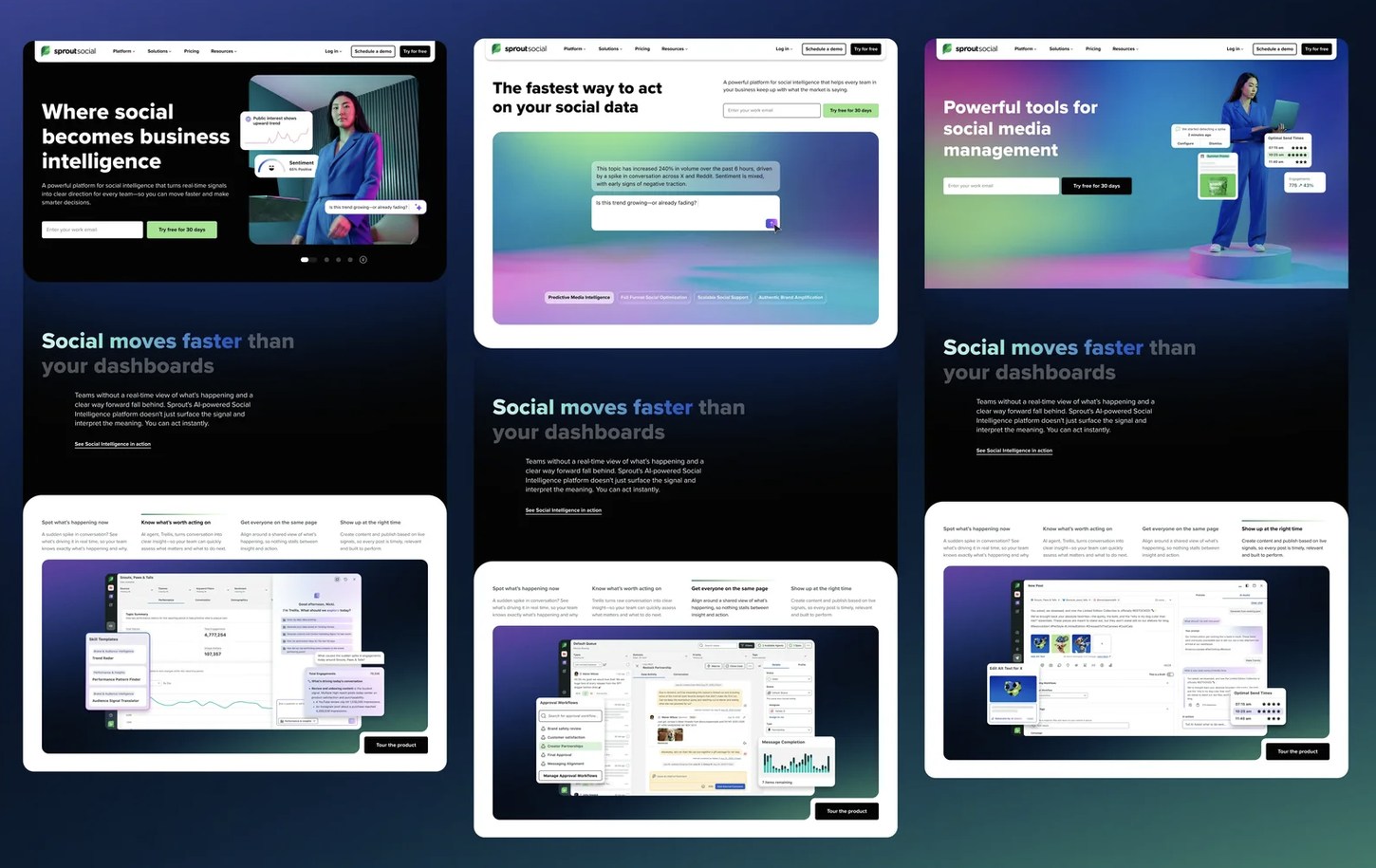
Homepage variants: A/B/C
The Why Sprout page supported the decision stage. The homepage could introduce the shift, but the full value proposition required more room to unfold. This experience gave buyers the context needed to understand how Social Intelligence translated into business outcomes and why Sprout was positioned to help organizations put this broader view of Social Intelligence into practice.
The page introduced the four solutions of Social Intelligence: predictive media, full-funnel optimization, scalable social support and authentic brand amplification. Together, they translated the category from an idea into a set of customer opportunities, showing how organizations could use social intelligence across different parts of their business.
Bringing the Category to Market
The launch moment brought the new definition of Social Intelligence into the market through three connected experiences.
-
The 2026 Social Intelligence Report gave the category shift a broader perspective grounded in customer and market understanding. Brand & Customer Insights research helped shape the report, bringing evidence into the conversation around how organizations were using social data and where they were still struggling.
The research reinforced the customer problem at the center of the category shift: organizations had access to valuable social signals, but many struggled to translate those signals into decisions across the business. The Report gave customers, executives and sellers a stronger reason to understand why Social Intelligence was becoming more important.escription text goes here
-
Breaking Ground was the moment where the category promise became tangible.
The event connected Social Intelligence to Sprout’s product evolution, showing how AI-powered capabilities and Trellis could help organizations move from collecting social signals to acting on them and giving customers a clearer understanding of how the product supported the broader Social Intelligence vision.
Breaking Ground showed customers what became possible when intelligence could move through the organization faster.
-
Cannes extended the Social Intelligence story into the executive audience that would influence the next stage of adoption.
The experience was designed for senior marketing leaders, customers and partners, combining executive meetings, dinners, partner activations and industry conversations.
The objective was relationship building and pipeline warming. These were enterprise conversations that would mature over time, not opportunities expected to close during the event itself.
The team achieved a 100% show rate for executive meeting sessions, creating meaningful engagement with the leaders who would shape the next stage of adoption.
Cannes gave Social Intelligence a place in the broader industry conversation and helped position Sprout around the future of how organizations understand customers and markets.
Results
The Social Intelligence launch achieved 105% of its pipeline goal.
The homepage maintained the acquisition performance needed to support the business while introducing a broader category story.
Cannes built momentum with enterprise audiences, strengthening relationships with the leaders shaping the next stage of adoption.
The launch gave Product, Marketing, Revenue and Brand a shared way to explain how Sprout was evolving.
Why This Matters
I’ve learned that changing how a company is understood in the market takes more than a launch moment. It requires building the belief system before asking customers to change their behavior.
The Social Intelligence work was a good example of that. The company had a strategic direction, the product was evolving and the market opportunity was there. The work was connecting those pieces into a story customers could understand and teams across the business could carry forward.
That is the role I have continued to build toward as a Brand Creative leader: entering when the business problem is still taking shape, helping define what customers need to believe and creating the systems that allow teams to bring that belief to life.